
Article index
Did you know that 78% of Vietnamese internet users have already interacted with AI platforms in the last three months? Yet most businesses are still stuck using basic chatbots that frustrate customers with their rigid, text-only responses. The game is changing—and Voice AI combined with multimodal capabilities is emerging as the breakthrough solution that Vietnamese SMEs need to transform their customer service from a cost center into a competitive advantage.
In October 2025, voice-enabled AI assistants are no longer science fiction—they're the frontline of customer engagement. As Vietnam races toward its digital transformation goals with 89% of businesses already using AI in marketing, the question isn't whether to adopt Voice AI, but how quickly you can implement it before your competitors do.

Modern Voice AI systems are transforming how Vietnamese businesses interact with customers through natural, human-like conversations
1. The Voice AI Revolution: Why Vietnamese Businesses Can't Afford to Wait
Traditional customer service in Vietnam faces a critical bottleneck. With internet penetration soaring and e-commerce booming, customer inquiries have increased by 65% post-pandemic, yet staffing shortages mean many customers wait minutes—or even hours—for responses. This is where Voice AI enters as a transformative solution, not just automating responses but actually understanding context, emotion, and intent through natural language processing.
The Vietnamese Market Reality
- Market Growth: Vietnam's AI market reached $750 million in 2024 with an annual growth rate exceeding 30%, driven primarily by SME adoption in retail, banking, and logistics sectors.
- Consumer Readiness: With 78% of online users already comfortable with AI interactions, Vietnamese customers are more receptive to Voice AI than ever before—especially Gen Z users who show 86% adoption rates.
- Cost Pressure: Vietnamese SMEs report that 75-80% of customer service time is spent on manual documentation and repetitive queries—time that Voice AI can reclaim for strategic activities.
Real Impact: Efficiency Gains
Recent studies show that businesses implementing Voice AI in customer service report a 25% increase in operational efficiency and a 35% boost in customer satisfaction scores. More impressively, call handling time drops by 30-40%, and First Contact Resolution rates jump from 65% to over 85%.
Why Voice Beats Text-Only Chatbots
- Natural Interaction: Voice feels more human and less robotic than typing, reducing customer frustration and increasing engagement—critical for Vietnam's relationship-focused business culture.
- Accessibility: Voice AI serves customers who prefer speaking to typing, including older demographics and busy professionals who multitask while getting support.
- Speed: Speaking is 3-4 times faster than typing, dramatically reducing average handling time and improving customer experience.
Success Story: Vietnamese retailers implementing Voice AI report cutting video production time from 8-10 hours to just 2 hours, while content creators leverage AI to scale their output without sacrificing quality—demonstrating Voice AI's versatility beyond just customer service.
2. Multimodal AI: The Next Frontier Beyond Voice
While Voice AI alone delivers impressive results, the real breakthrough comes when we combine it with multimodal AI—systems that can simultaneously process text, images, audio, and video to create truly intelligent customer interactions. This isn't just an incremental improvement; it's a fundamental shift in how AI understands and responds to customer needs.
Understanding Multimodal AI
Traditional AI systems process one type of data at a time—either text, or audio, or images. Multimodal AI breaks down these silos, analyzing multiple data streams simultaneously to gain deeper context and deliver more accurate responses. Think of it as the difference between reading a text description of a problem versus seeing it, hearing about it, and understanding the emotional context all at once.

Multimodal AI integrates voice, text, and visual data for comprehensive customer understanding
- Voice + Text Analysis: The system listens to what customers say while also analyzing their written queries, detecting inconsistencies or additional context that improves understanding.
- Sentiment Detection: Beyond words, multimodal AI analyzes tone, speech patterns, and even silence to gauge customer emotions—frustration, confusion, satisfaction—and adapts responses accordingly.
- Visual Context: When customers share screenshots or images of issues, multimodal AI can "see" the problem while hearing the explanation, providing more accurate troubleshooting.
Vietnamese Market Application
For Vietnamese e-commerce platforms, multimodal AI means understanding a customer's spoken query about a product while simultaneously analyzing their browsing history, viewing the product images they're interested in, and reading their past reviews—all to deliver perfectly personalized recommendations in real-time.
Practical Use Cases for Vietnamese SMEs
- Retail & E-commerce: Customers can speak their order inquiries while the AI views their purchase history and product images to provide accurate recommendations and resolve issues faster.
- Banking & Finance: Voice verification combined with document analysis ensures secure, efficient account management and fraud detection.
- Healthcare: Patients can describe symptoms verbally while providers access medical records and imaging, enabling faster preliminary assessments.
Cost-Benefit Reality: While multimodal AI might sound expensive, Vietnamese companies implementing these solutions report 30-40% cost savings compared to traditional call centers, with the investment typically paying for itself within 6-12 months through efficiency gains and reduced staffing needs.
3. Implementation Strategies: From Pilot to Scale
Understanding Voice AI and multimodal capabilities is one thing—successfully implementing them in your Vietnamese business is another. Based on successful deployments across Vietnam's SME landscape, here's a proven roadmap that balances ambition with practical constraints.
Phase 1: Strategic Foundation (Month 1-2)
- Identify High-Impact Use Cases: Start with repetitive, high-volume queries that consume the most customer service time. Common examples include order tracking, appointment scheduling, account inquiries, and basic troubleshooting.
- Data Preparation: Voice AI performs best when trained on your specific business context. Collect transcripts of actual customer interactions, document common queries and responses, and identify your key business rules and workflows.
- Choose the Right Platform: For Vietnamese businesses, prioritize platforms offering Vietnamese language support (including dialect recognition), local data hosting for compliance, and integration with existing systems like your CRM or e-commerce platform.
Technology Partner Selection
Look for AI solution providers with proven experience in the Vietnamese market who understand local business practices, language nuances, and regulatory requirements. Partners should offer not just technology but also training, ongoing support, and continuous optimization—exactly what Kachersoft provides to Vietnamese SMEs.
Phase 2: Pilot Deployment (Month 3-4)
- Start Small: Launch with one specific customer service channel or product line. This contained approach lets you test, learn, and refine without risking your entire operation.
- Hybrid Model: Implement a human-in-the-loop approach where Voice AI handles initial interactions and routine queries, but seamlessly transfers complex issues to human agents with full conversation context.
- Measure Everything: Track key metrics including First Contact Resolution rate, Average Handle Time, Customer Satisfaction Score, cost per interaction, and agent workload reduction.
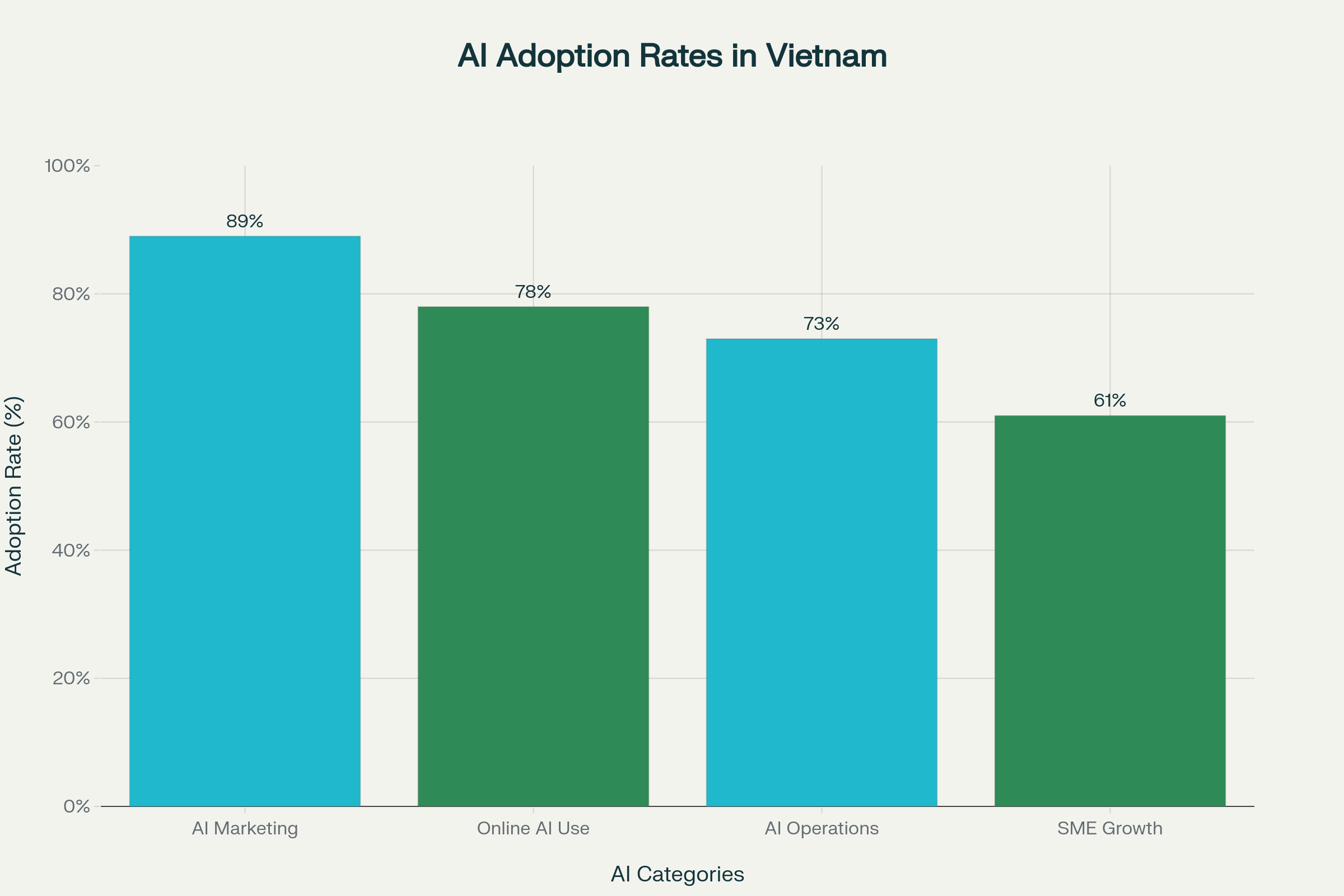
Vietnam leads ASEAN in AI adoption across multiple sectors, creating opportunities for Voice AI implementation
Phase 3: Scale and Optimize (Month 5+)
- Expand Gradually: Based on pilot results, roll out Voice AI to additional channels, product lines, or customer segments. Use learnings from the pilot to accelerate implementation.
- Continuous Learning: Voice AI systems improve through machine learning. Regularly review conversation logs, customer feedback, and performance metrics to identify optimization opportunities.
- Team Training: Your human agents shift from handling routine queries to managing complex issues and training the AI. Invest in upskilling your team to work effectively alongside AI systems.
Vietnamese Context Consideration: Given Vietnam's 30%+ AI market growth rate and government support through the National AI Strategy 2025-2030, early adopters gain significant competitive advantages. With 89% of businesses already using some form of AI, delaying Voice AI implementation means falling behind, not catching up.
4. Overcoming Common Implementation Challenges
Despite Voice AI's compelling benefits, Vietnamese SMEs face real obstacles during implementation. Understanding these challenges upfront and having mitigation strategies ready dramatically increases your success probability.
Challenge 1: Vietnamese Language Complexity
Vietnamese presents unique linguistic challenges for AI systems—tonal variations, regional dialects (Northern, Central, Southern), and the mix of formal and informal language patterns can confuse generic AI models trained primarily on English or Mandarin.
- Solution: Work with AI providers who have invested specifically in Vietnamese language models. Look for systems trained on diverse Vietnamese speech patterns that can recognize different accents and tones accurately.
- Action Step: During vendor evaluation, test the system with recordings in different Vietnamese dialects and informal speech patterns common in your customer base.
Localization Matters
Solutions built for Vietnamese language patterns and cultural context can handle local accents and phrasing better than generic platforms. Test each option on your own recorded calls before you choose.
Challenge 2: Integration with Existing Systems
Most Vietnamese SMEs run a patchwork of systems—perhaps a basic CRM, separate accounting software, e-commerce platforms, and maybe social media selling channels. Getting Voice AI to work seamlessly across this ecosystem feels daunting.
- Solution: Prioritize AI platforms with robust API capabilities and pre-built integrations for popular Vietnamese business tools. Many modern Voice AI solutions offer no-code/low-code integration options that don't require extensive technical expertise.
- Action Step: Map your current technology stack and customer journey before selecting a Voice AI platform. Choose solutions that integrate with your most critical systems first, then expand integration over time.
Challenge 3: Data Privacy and Compliance
With voice data containing sensitive customer information, Vietnamese businesses must navigate both local data protection regulations and customer privacy concerns. This is especially critical for sectors like finance, healthcare, and e-commerce.
- Solution: Select Voice AI providers who offer local data hosting within Vietnam, comply with Vietnamese data protection regulations, and provide clear data handling policies. Implement strict access controls and regular security audits.
- Action Step: Develop transparent privacy policies that explain how Voice AI uses customer data, obtain appropriate consents, and give customers options to opt for human-only interactions if preferred.
5. The Competitive Advantage: Why Early Adopters Win
In Vietnam's fast-moving digital economy, timing matters. Businesses implementing Voice AI and multimodal systems now gain compounding advantages that become harder for competitors to overcome as time passes.
First-Mover Benefits in the Vietnamese Market
- Customer Experience Leadership: Be the first in your industry to offer 24/7 intelligent voice support, creating a perception of innovation and customer-centricity that builds lasting brand differentiation.
- Data Advantage: Every customer interaction trains your AI system to better serve your specific market. Early adopters accumulate months or years of proprietary learning that competitors can't easily replicate.
- Operational Efficiency: While competitors struggle with rising customer service costs, your Voice AI-enabled team handles 2-3x more inquiries without proportional cost increases, freeing resources for business expansion.
- Talent Retention: Modern AI tools make customer service roles more interesting and less repetitive, helping you attract and retain better talent in Vietnam's competitive labor market.
Market Window Closing
With Vietnam's AI adoption rate at 78% among online users and 73% of companies already integrating AI into operations, the "early adopter" window is narrowing. Within 12-18 months, Voice AI will shift from competitive advantage to competitive necessity—similar to how website and mobile apps evolved from differentiators to basic requirements.
ROI Timeline You Can Expect
Vietnamese SMEs implementing Voice AI typically see measurable returns within 6-12 months:
- Months 1-3: Reduced call wait times, initial efficiency gains, positive customer feedback on 24/7 availability.
- Months 4-6: 20-30% reduction in customer service costs, improved First Contact Resolution, freed-up human agents for complex issues.
- Months 7-12: 30-40% total cost savings, measurable customer satisfaction improvements, capacity to handle seasonal peaks without temporary hiring.
- Year 2+: Compounding advantages as your AI system becomes increasingly sophisticated, potential to export your Voice AI capabilities to other markets or product lines.
Ready to Transform Your Customer Experience?
The Voice AI revolution isn't coming to Vietnam—it's already here. With 89% of businesses using AI in marketing and 78% of customers comfortable with AI interactions, the question isn't whether Voice AI will transform your industry, but whether you'll be leading that transformation or scrambling to catch up.
Assessment
Evaluate your current customer service bottlenecks and identify high-impact use cases where Voice AI can deliver immediate value.
Partnership
Connect with AI solution providers who understand Vietnamese business context and can guide you from pilot to scale.
Action
Start your Voice AI pilot within 30 days—before your competitors do. The cost of delay increases daily.
At Kachersoft, we specialize in helping Vietnamese SMEs navigate AI adoption with practical, results-focused solutions. Our approach combines cutting-edge technology with deep understanding of Vietnam's unique business environment, and we measure your Voice AI results against a clear baseline from the first pilot.
The Path Forward: Your Next Steps
Implementing Voice AI doesn't require massive upfront investment or complex technical expertise. What it requires is a strategic approach, the right partner, and the willingness to start. Vietnamese businesses that embrace Voice AI and multimodal capabilities now will define their industries' customer experience standards for years to come.
The data speaks clearly: 61% of Vietnamese SMEs using AI report average revenue increases of 16%. The technology is proven, the market is ready, and the competitive window is open. The only question remaining is: will you lead this transformation in your industry, or watch from the sidelines as your competitors do?
Start Your Voice AI Journey Today
Contact Kachersoft to discover how Voice AI and multimodal solutions can transform your customer service, reduce costs, and create lasting competitive advantages in Vietnam's dynamic digital economy.
The path forward
Start with assessment, partnership, and one measured pilot.
Talk to an expert